How to Rank in ChatGPT as a Local Business
There is no fixed ChatGPT ranking. Here is what we found in 318 AI answers about GTA local businesses, and the steps that make yours easier to recommend.
By RankSimply ·
Quick answer: ChatGPT doesn't keep a fixed list of local businesses. Each time someone asks, it searches the web, reads a handful of pages, and writes a fresh shortlist. To show up more often:
- let OpenAI's search crawler read your site
- find out which websites ChatGPT reads for your type of business
- make sure those pages say clearly what you do, where, and for whom
- check the result many times, not once
The sources that matter change by industry. In our scans:
- For dentists, ChatGPT mostly read the practices' own websites.
- For law firms, it leaned on the awards and rankings those firms' sites mention.
- For commercial cleaners, it leaned much more on directories and "best of" lists.
What "ranking" in ChatGPT actually means
On Google, a page has a position you can track. ChatGPT works differently. When a customer asks "who's the best personal injury lawyer in Toronto?", it runs its own web searches, picks pages to read, and names the businesses those pages support.
Two things follow from that:
- There is no position one. The same question can produce a different list when asked again.
- You are judged by what the web says about you, not only by your Google Business Profile.
Here is an example from our own data. We asked ChatGPT the same Toronto car-accident lawyer question twice. The first answer named 13 firms and the second named 7. Only two firms appeared in both.
So a single check tells you very little. What matters is how often you appear across many checks, and for which questions.
What we looked at
We ran the same customer-style questions through ChatGPT, Perplexity, and Gemini with web search switched on. Each question went to each assistant twice.
| Industry | Area | Questions | Answers | Date |
|---|---|---|---|---|
| Dentists | Toronto, Etobicoke, Mississauga | 21 | 126 | June 29, 2026 |
| Personal injury lawyers | Toronto, Mississauga | 14 | 84 | June 29, 2026 |
| Commercial (office) cleaning | Ajax, Oakville, Pickering, Richmond Hill, Toronto, Vaughan | 18 | 108 | November 1, 2026 |
That is 318 answers in total. We recorded every link each answer cited. Then we counted an answer as "citing a third-party source" if it linked to at least one of these:
- a directory or review site, such as Opencare, HelloDent, RateMDs, Yelp, Homestars, BBB, Bark, or Yellow Pages
- a "best of" or ranking list, such as Three Best Rated, Best Lawyers, Lexpert, or Canadian Lawyer
- a forum, such as Reddit
Social media pages and Google links weren't counted.
We ran the questions through each assistant's developer access, not a logged-in account. A logged-in customer may see results shaped by their own history or location. Treat the numbers as a snapshot, not a law.
Finding 1: ChatGPT's sources depend on your industry
Share of answers that cited at least one directory, review site, ranking list, or forum:
| Industry | ChatGPT | Perplexity |
|---|---|---|
| Dentists | 19% (8 of 42) | 88% (37 of 42) |
| Personal injury lawyers | 25% (7 of 28) | 79% (22 of 28) |
| Commercial cleaning | 58% (21 of 36) | 83% (30 of 36) |
Dentists. In most dentist answers, ChatGPT backed its picks only with the practices' own websites.
Law firms. ChatGPT also mostly linked to the firms' own sites. Its reasons were often third-party honours, such as Canadian Lawyer or Best Lawyers rankings, which it found on those sites.
Commercial cleaners. More than half of ChatGPT's answers linked to lists such as Three Best Rated, Homestars, or BBB.
Perplexity cited third-party sources in most answers in every industry. It cited Reddit often for dentists and lawyers.
We couldn't sort Gemini's sources. Its answers link through Google redirect addresses that hide the original site.
What this means for you: before you buy listings or write blog posts, find out which kind of source your industry runs on.
- A dental practice with a thin website has a website problem.
- A law firm may need recognition it can earn and then show on its site.
- A cleaning company missing from the lists ChatGPT reads has a listings problem.
Finding 2: ChatGPT gives a concrete reason for each pick
ChatGPT rarely named a business without saying why. Many of those reasons went beyond what the customer asked for:
- 10 of 42 dentist answers mentioned evening hours.
- 20 of 28 lawyer answers mentioned contingency fees ("no win, no fee" arrangements).
Those details have to come from somewhere it can read. An assistant recommends you for something. A page that says plainly "we take new patients for emergency visits in Etobicoke, including Saturdays" gives it a reason to name you for that question.
How to rank in ChatGPT: the steps, in order
1. Let OpenAI's search crawler read your site
OpenAI runs a crawler called OAI-SearchBot that finds pages for ChatGPT's search answers. OpenAI says sites that block it won't be shown in ChatGPT search answers, apart from plain navigational links.
Check your robots.txt file and any firewall or CDN bot settings. A separate crawler, GPTBot, collects content for model training. OpenAI treats the two settings independently, so you can allow search without allowing training. OpenAI says robots.txt changes can take about 24 hours to take effect.
2. Find out which sources ChatGPT uses for your business
Ask ChatGPT the questions your customers ask, such as "best family dentist in Mississauga accepting new patients," with search on. For each answer, note:
- which businesses it names
- which websites it links to
- what reason it gives for each pick
Repeat each question several times. If the same directories keep appearing, they are part of your work list. If only practice or firm websites appear, your own site is the lever.
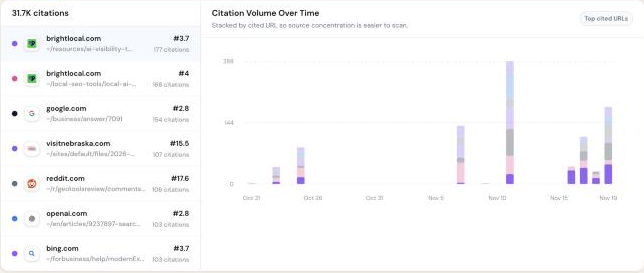
Here is what that looks like for our own business in RankSimply. For each tracked question, it shows which sites the AI cited instead of ours, where it can see them. For one software-comparison question, ChatGPT cited BrightLocal pages rather than ranksimply.io:

Across all tracked questions, counted across every run since October, the citations view ranks the pages AI answers cite most often. For our questions, these included BrightLocal guides, a Google help page, a Reddit thread, and an OpenAI help article:
Our free AI visibility report runs this kind of check for you. For a manual method, see how to audit your AI search presence.
3. If ChatGPT reads business websites in your industry, fix your pages
Give each main service its own page that says plainly:
- what you do
- who it's for
- where you are
- when you're open
- whether you're taking new clients
Write the sentence you'd want ChatGPT to quote. Keep facts identical across your site, Google Business Profile, and other profiles.
For dental practices, our post on getting recommended for one appointment type first walks through this. Ontario dentists and lawyers should check their regulator's advertising rules (the RCDSO or the Law Society of Ontario) before making claims like "best" or "top," or using testimonials.
4. If ChatGPT reads directories in your industry, get on the right ones
Make sure you are listed, accurate, and complete on the specific sites ChatGPT cited in your checks. Don't try to cover every directory that exists.
For trades and commercial services, that often means review platforms and "best of" roundups. For law firms it can mean editorial rankings, which you earn rather than buy. Our guide to local citation cleanup for AI search covers the order to work in.
5. Build reviews that describe the work
Assistants quote what reviews say, not only the star rating. Ask genuine customers to mention the service they got and where.
Don't script reviews or offer incentives. See our review strategy for AI recommendations.
6. Claim your business in ChatGPT, if you're eligible
OpenAI now offers Business Hub, where a verified owner can update their business details and see insights such as mentions and website clicks. At the time of writing, OpenAI says local stores and restaurants can only claim existing U.S. listings.
OpenAI also says claiming a profile doesn't change its visibility in ChatGPT. It's worth doing for accuracy, but it isn't a shortcut to being recommended.
7. Measure across many runs, and track the visits
Because answers vary, track how often you're named across a fixed set of questions every week or month. A single screenshot isn't a measurement.
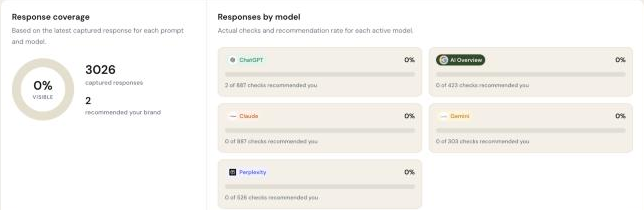
We hold ourselves to the same standard. Here is RankSimply's own starting point: across 3,026 captured AI responses to the questions we track, our brand was recommended twice, both times by ChatGPT, in 2 of 887 checks (about 0.2%). Our questions are about software like ours, not local services, but the method is the same. That's the baseline we'll measure this work against.
Links that ChatGPT cites often carry a utm_source tag, such as utm_source=chatgpt.com or utm_source=openai. Visits from those links can show up as their own source in your analytics. See how often to check AI recommendations and how to measure AI search referrals.
What owners keep asking
We reviewed dozens of threads from Reddit, Quora, and OpenAI's community forum where business owners and marketers asked about ChatGPT recommendations. These are the questions that came up most, with our answers.
"We rank on page one of Google. Why doesn't ChatGPT mention us?"
This came up often, including from the SEO manager of a restaurant with more than 1,200 Google reviews, and a web designer whose site ranked well on Google.
A Google ranking and a ChatGPT recommendation are built from different evidence. Google ranks a page. ChatGPT reads several pages and names the businesses those pages give it a clear reason to name.
In our scans, ChatGPT's picks for dentists were backed mostly by practice websites. For cleaners, more than half its answers cited at least one third-party list. If you rank well but none of the pages ChatGPT reads mention you for that question, ranking alone won't fix it. Start with step 2 above and look at what it actually cites.
"We've been in business for 30 years. Why does ChatGPT recommend newer firms?"
One lawyer wrote that their 30-year-old firm loses out to newer firms, and marketers describe the same pattern. ChatGPT can only use your years in practice if a page it reads states them clearly.
One possible reason, which we haven't tested: newer firms often have newer websites, with one page per service and plain statements of what they handle and where. In our lawyer scans, ChatGPT's reasons were things it could quote: contingency fees and published rankings such as Canadian Lawyer's.
An established firm whose site says little beyond "experienced, trusted, results" gives it less to work with. Put your track record in specific, checkable terms on the pages for each practice area.
"ChatGPT has the wrong information about my business. How do I fix it?"
Owners reported a competitor named as their owner, outdated listing data, and the wrong business name. ChatGPT builds answers from what it finds, so the fix is to correct the sources: your website first, then your main profiles and directories.
OpenAI's Business Hub lets eligible owners update their details. OpenAI notes that ChatGPT may still use other sources, so cleaning those up still matters. Our guide on fixing inaccurate AI business information covers the order to work in.
"Can I just tell ChatGPT about my business so it remembers?"
One owner described "teaching" ChatGPT about their business in a chat. Memory is tied to your own account and isn't shared with other users, so it won't change what a stranger sees.
To change what customers see, change what's published on the web.
"Does ChatGPT use Google Maps, Bing, or something else for local results?"
The threads disagree. Some say it mirrors Google listings, and others say it leans on Bing. OpenAI doesn't publish a full list of where local business data comes from.
What we can say from our own scans: ChatGPT rarely linked to Google listings, and mostly linked to business websites and, in some industries, directories. Keeping Google Business Profile, Bing Places, and Apple Business Connect accurate and consistent is cheap insurance either way.
"Why does ChatGPT give my customers different answers than it gives me?"
Answers change with wording, location, and simply asking again, so measure across many runs, as in step 7.
"Is an AI search (sometimes called GEO) agency worth paying for?"
It can be, if the agency shows you its work. Before you hire anyone, ask them to:
- show how your business currently appears, across repeated runs of the questions your customers ask
- name the specific sources they'll work on for your industry (your pages, particular directories, or particular lists)
- show before-and-after results measured the same way
Walk away from guaranteed placements. Nobody controls ChatGPT's answers. For a law-firm view of this question, see is AI SEO worth paying for if your firm already gets Google leads.
What won't help
- Paying for a "guaranteed #1 in ChatGPT." OpenAI doesn't publish a ranking formula, and the list changes between runs. No one can guarantee placement.
- Mass-producing blog posts. If your industry's answers cite directories, more posts on your own site are unlikely to change what ChatGPT cites.
- Checking once. One good or bad answer is noise. Look at the pattern.
For the broader factors behind AI recommendations, see why AI assistants recommend local businesses and what affects AI business recommendations.
Frequently asked questions
Can I pay OpenAI to be recommended in ChatGPT?
Not in the regular answers. Business Hub lets eligible businesses manage their information. OpenAI says claiming a profile doesn't change its visibility.
How long does it take to start showing up?
It depends on your market and on which sources ChatGPT reads for your industry. OpenAI says robots.txt changes can take about a day to register, but that doesn't mean you'll appear by then. Website and listing improvements take longer, because ChatGPT has to find and read them again.
Where to go from here
Start with step 2: find out what ChatGPT reads for your business. If you'd rather have someone run the checks and make the fixes, our done-for-you AI search optimization does that, and a person approves every change before it goes live.