Why AI Assistants Recommend Local Businesses
Why AI assistants recommend local businesses: learn how profiles, reviews, website content, citations, and schema support local AI visibility.
By RankSimply ·
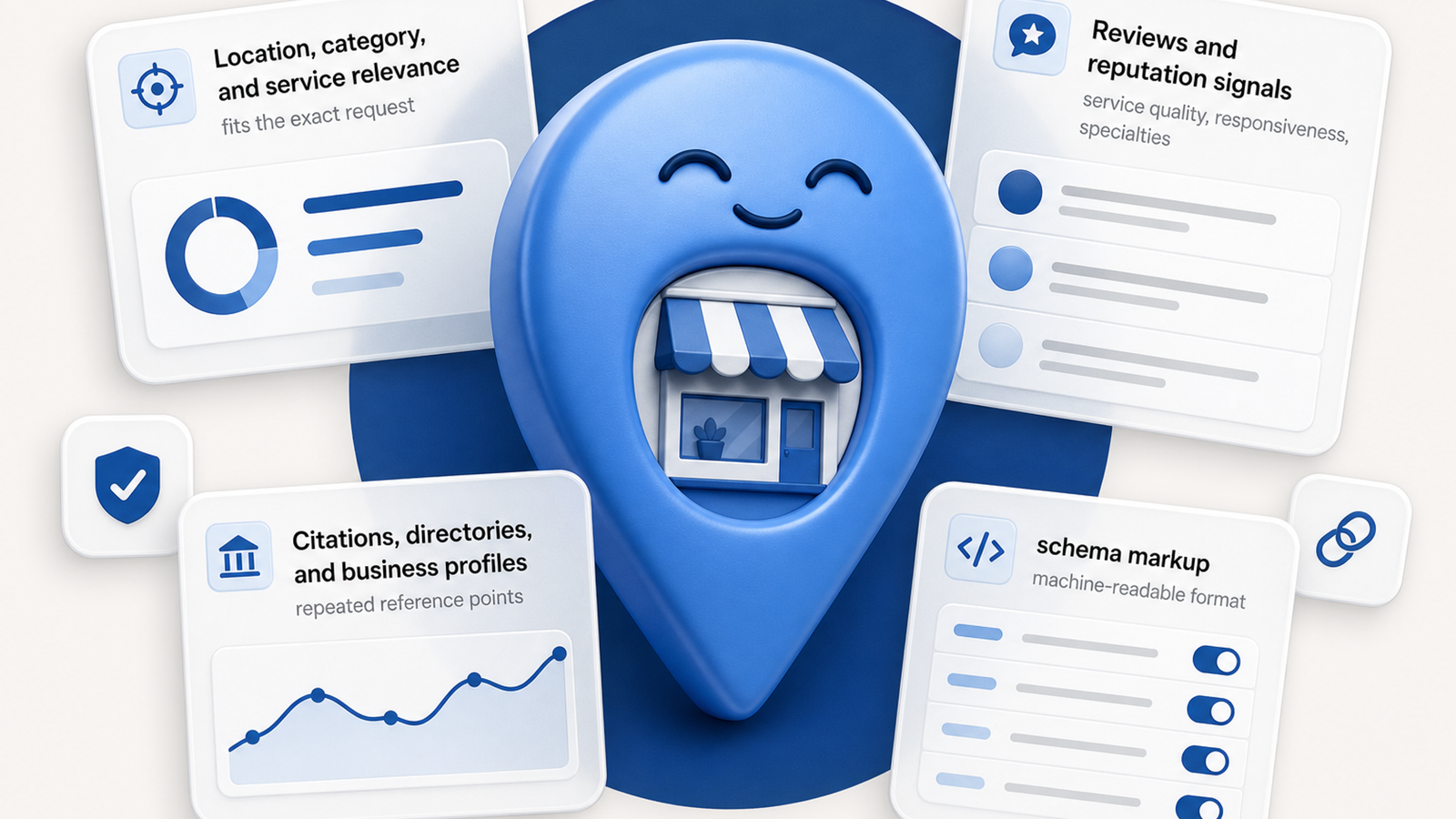
Quick answer: AI assistants recommend local businesses when they can connect a customer’s specific need with clear, consistent public evidence about the business’s services, location, customer fit, and reputation. Build one accurate business record, test the buying questions that matter, and use the answers to identify the next correction.
The outcome to aim for is straightforward: when customers ask priority questions, your business is described accurately, associated with the right service area, and supported by information they can verify.
AI visibility is not about publishing more pages for their own sake. It is about making it easy to confirm what your business does, where it serves, and why it fits a particular customer need. Your website, Google Business Profile, reviews, directories, and other public records should tell the same factual story.
Why do AI assistants recommend some local businesses instead of others?
AI assistants connect a customer’s request with the business information available to them. The more clearly a business addresses the service, location, urgency, and customer requirements in that request, the easier it is to include in a useful answer.
Consider the difference between these questions:
- “Who offers same-day furnace repair in North York?”
- “Which restaurant is family-friendly and open late?”
- “Who provides accessible dental appointments on weekends?”
Each question contains several decision criteria. A broad category label alone does not answer them.
A useful local-business record answers these questions clearly:
- What does the business offer?
- Which locations, neighbourhoods, or service areas does it serve?
- Which customer needs does it meet?
- Are important details such as hours, availability, or booking requirements accurate?
- Do reviews support the strengths the business claims?
- Do the website, profiles, and directories agree on core facts?
Consistent business facts give AI assistants one record to repeat. Conflicting, stale, or vague information makes it harder to connect a business with a specific request.
What information should a local business make clear?
For local discovery, your public information should help a customer answer two questions: “Is this business relevant to my need?” and “Can I trust the details?”
The most useful evidence areas are:
| Evidence type | What it clarifies | What to check first |
|---|---|---|
| Business profiles | Category, contact details, hours, location, services | Incorrect hours, category, website, or address |
| Website service pages | Services, customer fit, service areas, booking details | Thin or unclear descriptions of important services |
| Reviews | Customer experience and recurring service themes | Whether feedback supports the claims on your site |
| Citations and directories | Consistent business identity and local presence | Conflicting name, address, phone number, or URL |
| Local mentions | Independent context about the business | Old details or incorrect descriptions |
| Structured data | Machine-readable business facts | Markup that conflicts with visible content |
| Competitor evidence | Gaps in service, location, or customer-fit coverage | Repeated competitor appearances in priority prompts |
Start with factual accuracy. A strong service page cannot compensate for the wrong phone number, outdated hours, or an old address appearing across prominent public listings.
How do location, category, and service relevance affect recommendations?
Location, category, and service relevance determine whether a business fits the exact request, not simply whether it belongs to a broad industry.
A customer seeking an emergency plumber in a specific neighbourhood is looking for a different match than someone planning a bathroom renovation elsewhere in the city. The same principle applies to restaurants, clinics, professional services, retail stores, and home-service businesses.
Make these details clear on your website and public profiles:
- City, district, neighbourhood, or service area
- Core services and specialist services
- Same-day, emergency, weekend, or appointment availability
- Accessibility information
- Customer types or needs the business is equipped to serve
- Material service boundaries, eligibility requirements, or booking steps
Build pages around real decision points. A location page should accurately explain the office location or service area. A service page should explain the work, who it is for, and the details a customer needs before getting in touch.
For multi-location businesses, publish location-specific information rather than near-identical pages with city names swapped out. Useful details include local contact information, service boundaries, availability, common customer questions, and verified local information.
Why do reviews matter beyond star ratings?
Reviews add customer language to the public record. They can show what people experienced, including responsiveness, service quality, specialties, atmosphere, accessibility, or value.
This matters because recommendation questions often include qualitative requirements such as:
- Reliable
- Quick
- Child-friendly
- Accessible
- Experienced
- Affordable
- Helpful in an emergency
When customers genuinely mention these themes, reviews provide useful supporting context for the strengths presented on your website and profiles.
A practical review process is simple:
- Request feedback after a real job or visit.
- Monitor new reviews for recurring themes and unresolved issues.
- Draft accurate, professional responses where a response is appropriate.
- Use legitimate recurring themes to improve service pages and FAQs.
- Compare review themes with the claims on your website and profiles.
RankSimply can send review requests after each job or visit, follow up politely when customers have not replied, and draft every new review reply in the business’s voice for approval. Its review monitor covers Google, Yelp, and Facebook.
How do citations, directories, and business profiles help?
Citations, directories, and business profiles repeat the facts customers need to verify: business name, address, phone number, website, hours, categories, and service area.
Start with a single approved source of truth containing:
- Business name
- Address or service-area information
- Primary phone number
- Website URL
- Opening hours
- Primary category and core services
- Business description
Then compare that record with the public profiles and directories customers are likely to encounter.
A Google Business Profile is particularly important for Google-related local discovery. Keep its category, hours, location, website, services, and contact details aligned with your website and other public records.
Prioritize corrections that can change a customer decision:
- Incorrect name, address, phone number, website, or hours
- Wrong category or missing service information
- Duplicate listings and old locations
- Conflicting service areas
- Broken profile links to relevant service or location pages
RankSimply coordinates profile, citation, review, content, and schema work because correcting one listing does not resolve a wider mismatch in public business information.
What does a local business website need?
A local business website should clearly state what the business offers, where it serves, who each service is for, and how customers can take the next step.
Important services should be easy to find and explained in plain language. A useful service or location page commonly includes:
- The service name and what it includes
- The relevant location, office, or service area
- Who the service is appropriate for
- Material scheduling, availability, or eligibility details
- Accurate contact and booking paths
- Links to related services and nearby locations
- Answers to factual customer questions
Avoid unsupported “best” claims, copied text, and pages written only to repeat a place name. A prospective customer should be able to use the page to decide whether the business fits their need.
A competitor can appear in a recommendation because its public information addresses the prompt more directly. Compare the exact service, location, review themes, cited sources, and customer questions behind recurring competitor appearances. For a diagnostic process, read why AI assistants recommend competitors.
How can schema markup reduce ambiguity?
Schema markup expresses business facts in a machine-readable format that matches visible website content. It can help systems interpret a business’s identity, location, contact information, hours, and services.
Google’s guidance for AI features and your website emphasizes helpful, reliable content and established technical requirements. For local businesses, that means marking up facts visitors can verify on the page.
Use schema as confirmation, not camouflage. Keep markup aligned with the visible page, your Google Business Profile, and directory records.
For many local businesses, the first schema priorities are:
- An appropriate organization or local-business type
- Business name, URL, and phone number
- Address or service-area details where relevant
- Opening hours
- Accurate service information
Schema is most useful after the underlying business facts are already aligned.
How should you check whether AI assistants recommend your business accurately?
Check a documented set of buyer-intent prompts across the AI and search surfaces that matter to your customers. Record what each answer says, whether your business is included, and the evidence behind recurring gaps.
ChatGPT, Gemini, Claude, Perplexity, Copilot, Grok, and Google AI Overviews are separate discovery surfaces. Google Search and Google Maps should also be tracked separately. See which AI tools recommend local businesses for a breakdown of what to monitor.
Some AI experiences display supporting links or citations. For example, ChatGPT Search can provide web links alongside answers. When sources are visible, inspect them. They can reveal outdated business details, weak service pages, or public information that gives a competitor a clearer connection to the prompt.
Build a repeatable prompt set
Start with a focused set of questions that reflect genuine customer needs, such as:
- A core service request
- An urgent problem
- A budget-sensitive request
- A question about hours or availability
- A request involving accessibility or customer fit
- A location-specific comparison
Use the actual language customers use. “Who offers same-day furnace repair in North York?” produces a more useful business check than “How does furnace repair work?”
For every check, record:
- The exact prompt
- Platform checked
- Date and market
- Businesses named
- Answer wording
- Visible citations or links
- Competitors included
This creates a before-and-after record for profile, citation, review, content, and schema work.
Separate a recommendation from a citation
A business can be cited as a source without being recommended. A source may also support a general answer without indicating that the business is the right choice for the customer’s request.
Review each result for:
- Whether the business was named as a recommendation
- Whether the description was accurate
- Which service and location it was associated with
- Which competitors were named instead
- Which sources were cited, where available
- Whether the citation supported a business recommendation or only general information
AI search visibility metrics such as recommendation presence, competitor displacement, source inclusion, and entity accuracy turn those observations into a focused action list.
RankSimply monitors selected prompts across ChatGPT, Claude, Gemini, Perplexity, Grok, Copilot, and Google AI Overviews. It records observed answers and citations, competitor share of voice, answer sentiment, and AI crawler user-agent activity. It also keeps Google AI Overview findings alongside local-pack and organic context.
What should you fix first when your business is missing?
Fix the largest evidence gaps first: confirm core facts, align profiles and citations, improve service and location pages, earn authentic reviews, add accurate schema, and then recheck the same prompt set.
Use this order:
- Establish the source of truth. Confirm the business name, category, location or service area, phone number, website, hours, and core services.
- Align profiles and citations. Correct material conflicts, duplicates, old URLs, incorrect hours, and category mismatches.
- Improve service and location pages. Explain the services and markets that matter to customers using facts your business can support.
- Request and respond to reviews. Focus on genuine customer feedback and recurring themes.
- Add accurate schema. Mark up business facts after confirming that visible content and public profiles agree.
- Recheck prompts and competitors. Run the same questions, inspect available citations, and compare recommendation presence and description accuracy.
RankSimply helps local and multi-location businesses monitor AI recommendations and coordinate profile, review, citation, schema, competitor, and content improvements. It also offers a free AI visibility report with no signup to identify observed recommendation gaps and the evidence areas to check first.
Frequently asked questions
Can you make ChatGPT recommend your local business?
Improve the public evidence ChatGPT can connect to customer questions: accurate service and location pages, aligned profiles and citations, authentic reviews, and schema that matches visible content. Then test buyer-intent prompts and compare the answer, competitors, and citations with the facts on your public pages.
Does a Google Business Profile affect AI assistant recommendations?
A Google Business Profile gives Google-related local experiences a record of your category, location, hours, website, services, and contact details. Keep it accurate and aligned with your website, reviews, directories, and other business listings.
Do more Google reviews help with AI recommendations?
Useful reviews provide customer evidence about the experience and services a business delivers. Focus on requesting genuine feedback after real jobs or visits, then compare recurring review themes with your service pages, profiles, and priority customer questions.
Why does an AI assistant recommend a competitor instead of my business?
A competitor may have a clearer connection to the specific prompt through more precise service information, stronger location relevance, consistent listings, relevant review themes, or supporting public sources. Compare the exact prompt, answer wording, visible sources, and repeated competitor appearances to find the evidence gap.
How often should a local business check AI recommendations?
Check a documented prompt set on a recurring schedule and after meaningful profile, content, review, citation, or schema changes. Use the same priority questions and markets for each review so you can identify changes in recommendation presence and business-description accuracy.
Use observed answers to prioritize the next correction
Start with the questions customers ask when they need your service. Compare the answers with your business facts and the competitors repeatedly included. Correct inaccurate or unclear information first, then recheck the same prompts to confirm that your business is described properly and supported by consistent public evidence.
RankSimply helps local and multi-location businesses monitor AI recommendations and improve the profile, review, citation, schema, competitor, and content signals behind them.