AI Visibility Software Versus SEO Tools
Compare AI visibility software versus SEO tools for local businesses: what each measures, where they overlap, and what to fix after missed AI recommendations.
By RankSimply ·
Quick answer: AI visibility software and SEO tools measure different parts of local discovery. SEO tools track organic search performance and site health. RankSimply monitors whether local businesses are mentioned or recommended across AI assistants and Google AI Overviews, then turns repeated gaps into profile, review, citation, schema, competitor, and content work. Check both views: rankings and local-pack positions for search visibility, plus recorded recommendation results for customer prompts.
AI visibility software versus SEO tools is not an either-or decision for most local businesses. Use SEO tools to manage technical health, organic rankings, keyword performance, backlinks, and search traffic. Use AI visibility software to record whether your business appears or is recommended when people ask ChatGPT, Gemini, Claude, Perplexity, Copilot, Grok, or Google for local help—and to assign work from repeated gaps.
What is the difference between AI visibility software and SEO tools?
AI visibility software measures how a business appears in generated answers and recommendation lists. SEO tools measure visibility in conventional search results and the work affecting those results.
For a local business, use both reports for different questions:
- AI visibility software: “When someone asks for a provider like us, does the answer include or recommend us?”
- SEO tools: “Where do our pages and listings appear in Google Search, and what is affecting that performance?”
The categories can share inputs, including keywords, locations, competitors, pages, business profiles, and search results. Their primary measurements differ.
- AI visibility software monitors a brand's presence in AI-generated answers and helps teams address missing, inaccurate, or weak business representation.
- AI recommendation monitoring records whether an answer tool recommends a business for a defined customer need, market, and prompt.
- SEO tools support rank tracking, technical audits, keyword research, backlink analysis, and organic-content measurement.
- Local entity signals are the facts and proof that identify a local business: its name, address, phone number, categories, services, hours, reviews, citations, website content, and structured data.
- Traditional organic visibility is a business's presence in unpaid search listings, including organic and local-pack results for tracked queries and markets.
A business name appearing in an answer is different from a recommendation. A recommendation presents the business as a suitable option for the customer's request. Track mentions, recommendations, Google rankings, website traffic, calls, and booked jobs as separate measures.
What does each type of platform actually measure?
AI visibility software records observed answers, business mentions, recommendations, cited sources, competitors, and answer accuracy for selected prompts. SEO tools record search positions, technical conditions, keyword demand, links, pages, clicks, and impressions.
| Comparison area | AI visibility software | SEO tools |
|---|---|---|
| Primary objective | Find recommendation and answer gaps | Improve organic-search performance |
| Surfaces monitored | AI answers and Google AI Overviews | Organic results, local packs, and websites |
| Core metrics | Mentions, recommendations, citations, and answer accuracy | Rankings, clicks, impressions, links, and technical issues |
| Typical actions | Improve profiles, reviews, citations, schema, competitor coverage, and content | Fix crawl issues, improve pages, track keywords, and assess links |
| Local-business relevance | Records whether customers encounter a recommendation | Records whether customers can find listings and pages in search |
| Relationship between the tools | Adds answer and recommendation evidence | Measures search and site performance |
Record each answer under the platform where it appeared. That creates a clean baseline for repeated checks and shows where your business is cited, mentioned, or recommended.
Google treats AI features as part of Search rather than as a separate publishing channel. Its AI features guidance explains that pages need to be indexed and eligible to appear in Google Search to be considered for AI features. Technical SEO, useful service pages, and accurate business information remain part of local AI visibility work.
When does a local business need AI visibility software in addition to SEO tools?
Add AI visibility software when customers ask answer tools who to hire, where to go, or which provider suits a specific need—and you need a record of whether your business is included.
Start with questions that matter commercially. Good prompts describe a service, market, and customer need without inserting your business name. For example, a business might track questions about providers for a specific service, a customer situation, or a neighbourhood it serves.
AI monitoring helps answer questions such as:
- Which local competitors appear in recommendation lists?
- Is the business named, recommended, or omitted?
- Are the stated services, locations, hours, and qualifications accurate?
- Which sources appear alongside the answer?
- Did recorded recommendation results change after local information was improved?
Rank tracking still has a separate job. Continue using Google Search Console, local-pack and organic rank tracking, technical site audits, backlink analysis, and conversion measurement. Those systems show whether searchers can find and use the business's website and listings. AI recommendation monitoring shows whether the business is surfaced when someone asks for help.
Which AI visibility features matter when customers ask for local recommendations?
The most useful AI visibility features connect repeated recommendation checks to specific local-business improvements. The system should preserve the prompt, market, answer, competitors, and sources, then connect an omission or error to a practical next action.
Prioritize these capabilities:
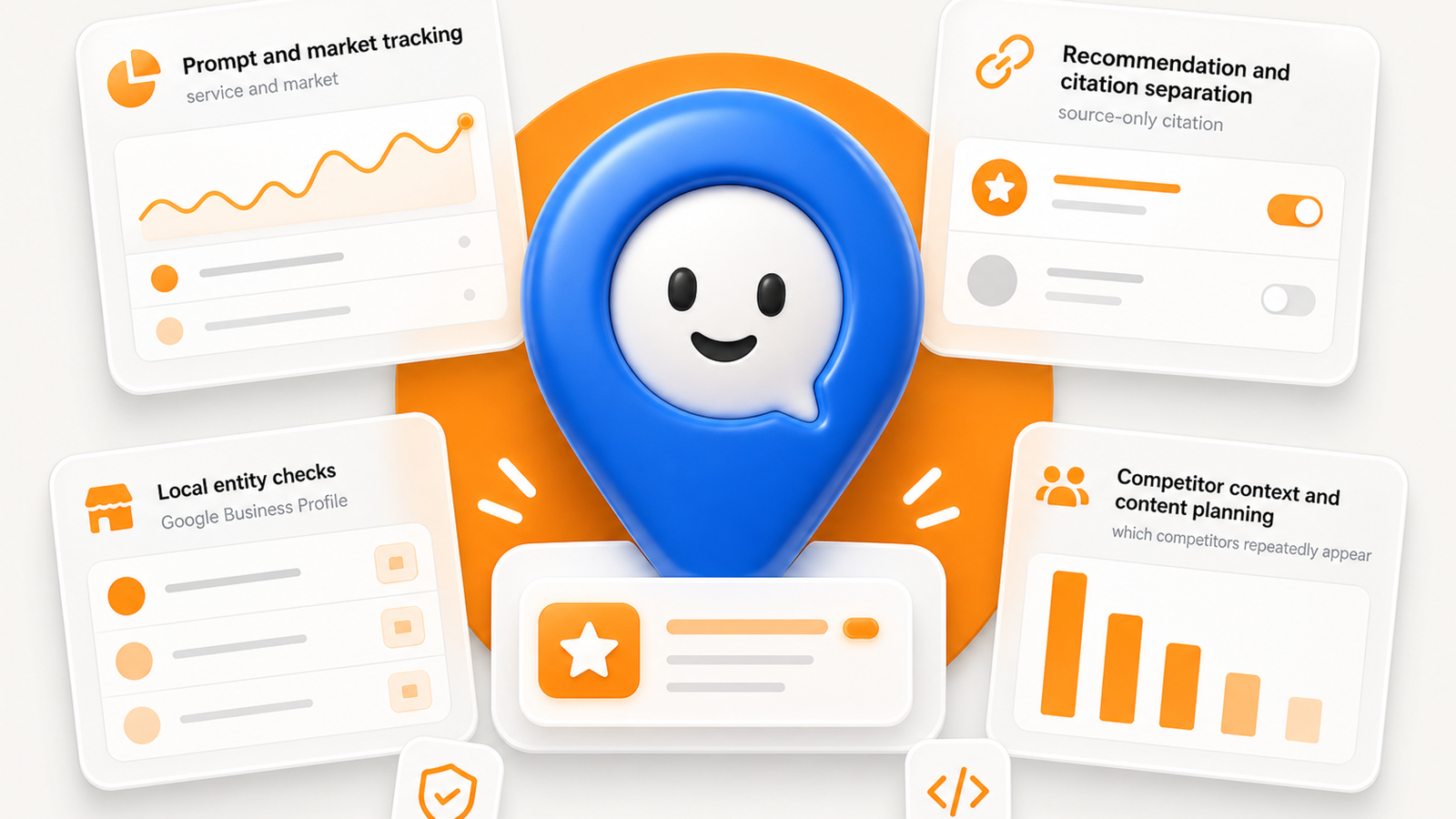
Prompt and market tracking
Track realistic customer prompts consistently by service and market. Record the exact wording, location context, date, platform, full response, competitors, and visible sources.
Use the same prompt set and market context for each review cycle. Compare the saved results after profile, review, citation, schema, or content work to identify which recommendation patterns changed.
Recommendation and citation separation
Separate a business recommendation from a source-only citation. An assistant can cite a business website or directory without presenting that business as an option for the customer.
This distinction directs the next task. A cited source may show that the business information is available; a missed recommendation calls for a closer review of the service information, local proof, competitor coverage, and customer need expressed in the prompt.
Local entity checks
A missed recommendation often points to incomplete or conflicting business information. Review the Google Business Profile, website location and service pages, primary directories, review profile, and structured data together.
Keep schema aligned with the visible page. Consistent business facts give search engines and AI assistants one clear record to identify and repeat.
Competitor context and content planning
A useful report shows which competitors repeatedly appear and what customer need the prompt expresses. That gives the team a focused research task: inspect competing service coverage, business facts, proof, and supporting pages before choosing the right fix.
The fix may be a profile update, citation correction, review process, schema improvement, or a new page with a distinct customer purpose.
RankSimply monitors selected prompts across ChatGPT, Claude, Gemini, Perplexity, Grok, Copilot, and Google AI Overviews. It records observed recommendations and citations, separates source-only citations from business recommendations, and pairs the findings with profile, review, citation, schema, competitor, and content work. A person approves every change before it goes live.
How should you compare AI visibility software with an existing SEO stack?
Compare AI visibility software by whether it converts missed local recommendations into accountable work, not by the size of a visibility score. Keep your SEO stack for technical, organic, keyword, link, and traffic analysis. Judge the AI layer by the quality of its prompt evidence, local context, and improvement workflow.
| If your current stack answers this question | Your existing SEO tools may be enough | Add AI visibility software when you also need this answer |
|---|---|---|
| Where do we rank in Google? | Yes | Are we recommended when customers ask AI assistants whom to choose? |
| Which pages get organic clicks? | Yes | Does an AI answer describe our services and locations correctly? |
| What technical issues affect crawling? | Yes | Which profile, review, citation, schema, or content task follows a missed recommendation? |
| Which keywords and competitors matter? | Yes | Which competitors appear in the recommendation answers we monitor? |
| Did traffic or leads change? | Yes | Did recorded AI-answer results change after a documented fix? |
For multi-location operators, keep evidence location-specific. A recommendation result for one location does not establish visibility for every branch, service area, or market.
The strongest fit gives marketing teams a repeatable baseline, identifies the local gap, assigns the next action, and monitors the same prompts again. Read our guide on how to audit AI search presence before building prompts and scorecards.
What should you do when an AI assistant does not recommend your business?
When an AI assistant does not recommend your business, save the result, inspect the business facts and proof behind the answer, fix the clearest gap, and monitor the same prompt set again.
Use this sequence:
- Save the observation. Record the prompt, market context, date, platform, full answer, competitors, and visible sources.
- Inspect the business profile. Check core facts, categories, services, hours, contact details, booking path, and location coverage on the website and Google Business Profile.
- Inspect the competitive set. Review the businesses that were recommended and identify the customer need associated with each competitor.
- Prioritize the evidence gap. Correct conflicting citations, improve incomplete location or service pages, request and reply to genuine reviews, or add schema that matches the visible page. Use local citation cleanup for AI search when business facts conflict across listings.
- Document the change. Record what changed, where it changed, and which prompt or business fact it addresses.
- Monitor again. Run the same agreed prompt set and compare the recorded recommendation, citation, competitor, and source results.
This process avoids a common mistake: publishing generic content because a business was omitted from one answer. The right response may be a corrected profile, clearer service information, stronger review management, reconciled citations, or accurate schema.
Can AI visibility software replace traditional SEO tools?
AI visibility software and traditional SEO tools serve separate reporting and workflow needs. SEO tools cover technical audits, organic rank tracking, Search Console analysis, backlink research, and page-level traffic measurement. AI visibility software adds recommendation monitoring and local-business improvement work.
Keep SEO tools for:
- Crawlability, indexing, redirects, and site errors
- Organic keyword and page performance
- Google Search Console clicks, impressions, and queries
- Local-pack and organic rank tracking
- Backlink and referring-domain research
- Content performance and conversion analysis
Use AI visibility monitoring to record whether a local business is included in an answer, actively recommended, associated with the right service and location, cited as a source, or omitted while competitors are named.
The practical stack uses both: SEO tools show search and site performance, while AI visibility software records local recommendation results and organizes the work that follows.
What is the next step for assessing local recommendation visibility?
Build a short list of high-intent customer questions, define the markets you serve, and establish a baseline across the AI assistants and Google surfaces that matter to your business.
Record whether your business is recommended, cited, or missing; name the competitors and sources shown; then assign profile, review, citation, schema, competitor, and content work from the findings. Run the same prompt set again after the work is complete to check the recorded change.
Start with RankSimply’s free AI visibility report. It requires no signup and gives you a starting point for evaluating local recommendation visibility.
Frequently asked questions
Is AI visibility the same as generative engine optimization?
AI visibility is the observed presence, accuracy, and recommendation status of a business in AI-generated answers. Generative engine optimization commonly describes the work intended to improve that presence.
For local businesses, the work is concrete: reconcile business facts, improve profiles and reviews, correct citations, add accurate schema, and publish pages that answer real customer needs.
Can an SEO tool show whether ChatGPT recommends my business?
Most SEO tools measure Google search performance, website conditions, keywords, and links rather than preserving observed ChatGPT recommendation answers.
A dedicated AI visibility workflow records the prompt, market, answer, recommendation status, competitors, and visible sources. It then compares repeated observations to show whether the business is appearing more often for the customer questions that matter.
Should local businesses buy AI visibility software before fixing their Google Business Profile?
Fix clear Google Business Profile errors first. Incorrect categories, hours, contact details, or services create a confused business record across local discovery surfaces.
AI visibility software becomes useful when the business needs a repeatable recommendation baseline and a process for identifying the remaining profile, review, citation, schema, competitor, or content gaps.
How often should I monitor AI recommendations?
Monitor AI recommendations on a repeatable schedule using the same agreed prompts, market context, and recording method. Weekly checks work well during active improvement work because they capture new observations after material updates.
Maintain a documented baseline and compare the same prompts at each review cycle. This shows whether the recorded recommendation pattern is changing.
Do better Google rankings guarantee visibility in AI answers?
Organic ranking measurement records where a page or listing appears in Google results. AI recommendation monitoring records whether an assistant includes or recommends a business for a specific customer prompt and market.
Strong local SEO supports both forms of discovery. Indexed pages, accurate business facts, useful service information, reviews, citations, and visible proof give search systems and customers clearer information to use.