AI Visibility Implementation Checklist: A Practical Guide
Use this AI visibility implementation checklist to align local business facts, profiles, reviews, schema, content, and monitoring.
By RankSimply ·
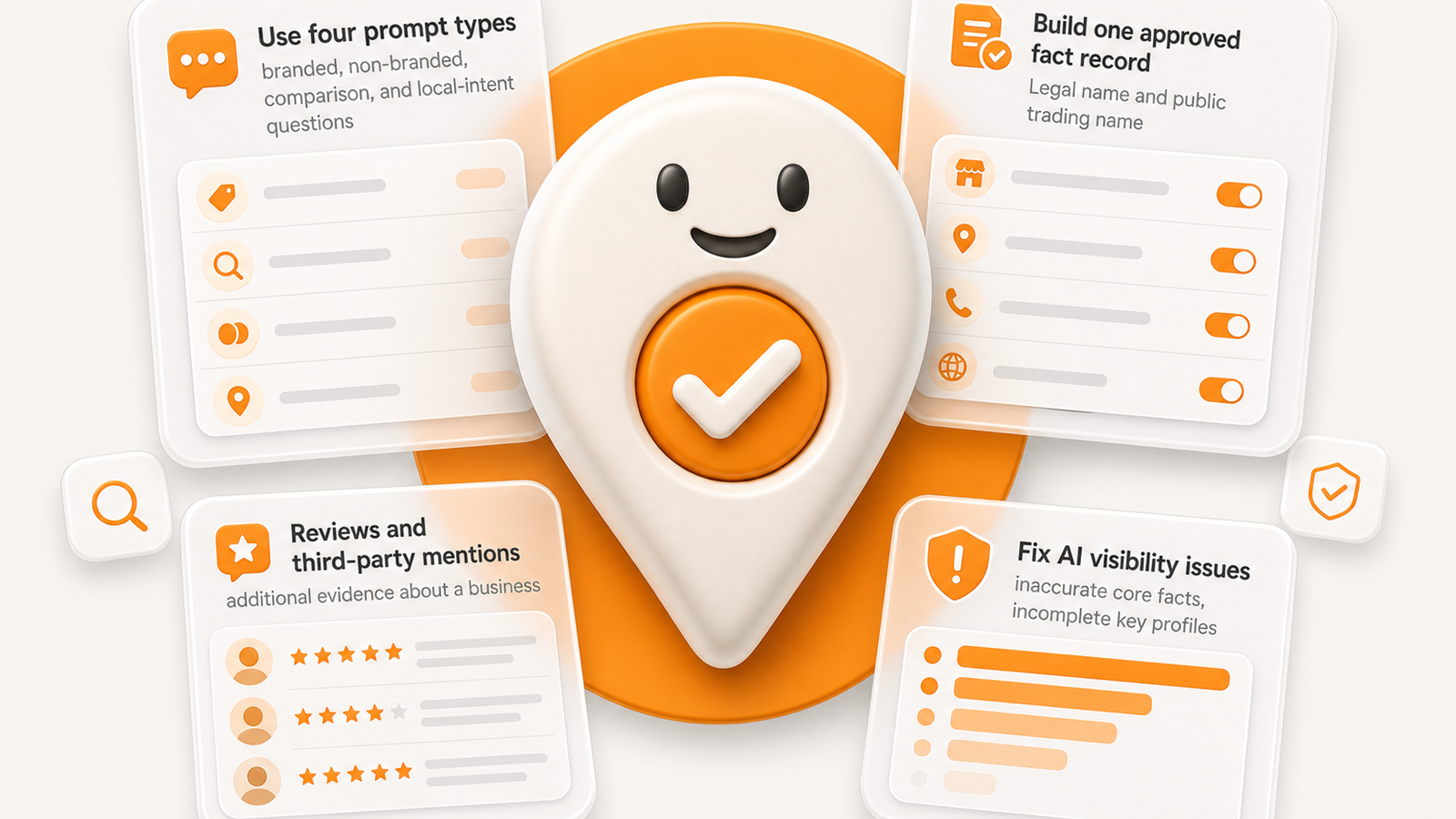
Quick answer: An AI visibility implementation checklist is a recurring process for making a local business easy to verify across its website, profiles, reviews, citations, structured data, and customer-facing content. Start with accurate business facts, complete priority profiles, clear service and location pages, genuine reviews, consistent citations, and schema that matches visible content. Then test the same customer questions repeatedly, fix the evidence gaps behind missing or inaccurate answers, and record what changes.
An AI visibility implementation checklist helps a local business build one accurate, corroborated record that AI assistants and Google can use when answering customer questions. Record current answers, correct factual conflicts across owned and third-party sources, publish clear decision-making information, and repeat the same checks over time.
RankSimply helps local and multi-location businesses monitor recommendations and coordinate the profile, review, citation, schema, competitor, and content work behind that process.
What is an AI visibility implementation checklist for a local business?
An AI visibility implementation checklist is an operating routine for local entity management: document what the business is, confirm where those facts appear, correct conflicts, and monitor how recommendation and search systems describe it. It is not a one-time prompt exercise or a technical SEO task completed after adding schema.
A customer asking for a provider usually needs answers to a few basic questions:
- Who serves this need?
- Where do they serve?
- What do they offer?
- Can they be contacted or booked?
- What proof supports the choice?
Your website can state those facts directly. Profiles, directories, reviews, local publications, and other independent sources can corroborate them. When those records conflict, reconcile the business record before publishing more content.
Use the checklist as a shared workboard, not a static document:
| Task | Evidence needed | Owner | Priority | Implementation status | Review cadence |
|---|---|---|---|---|---|
| Create a business-fact record | Approved facts and service coverage | Business owner | High | Not started | On every material change |
| Record a recommendation baseline | Saved prompts, answers, sources, dates | Marketing lead | High | Not started | Monthly |
| Correct core profiles | Profile screenshots and URLs | Profile owner | High | Not started | Monthly |
| Clean up citations | Listing inventory and corrections | Marketing lead | High | Not started | Quarterly |
| Run review workflow | Request, response, and escalation process | Operations lead | High | Not started | Weekly |
| Add accurate schema | Visible page content and markup validation | Web lead | Medium | Not started | On page changes |
| Improve service and location pages | Customer questions and approved proof | Content owner | Medium | Not started | Monthly |
| Compare recommendation evidence | Competitor mentions, sources, and gaps | Marketing lead | Medium | Not started | Monthly |
The outcome is straightforward: when you inspect a relevant answer, you can identify its supporting facts, find incorrect claims, assign a correction, and verify the record again in the next review.
What should you baseline before you change anything?
Baseline the answers customers receive before making changes by saving a small, repeatable set of branded, non-branded, comparison, and local-intent questions. For every check, record the prompt, location context, date, platform, business mention, recommendation status, factual accuracy, competitors named, and visible sources.
One branded prompt only tests whether a system recognizes your name. It does not test whether a customer can discover you when they ask for help without knowing your business already exists.
Build a prompt set around real customer decisions. Use one service and one market at a time so the result is useful to the team responsible for that location.
Use four prompt types
- Non-branded discovery: “Which businesses help with [service] in [market]?”
- Branded accuracy: “What services does [business name] provide in [market]?”
- Comparison: “How does [business name] compare with other [category] options in [market]?”
- Local-intent decision: “Who should I contact for [specific need] in [market]?”
Create a log with the exact question, market, date, response text or screenshot, sources shown, and a simple score: absent, mentioned, recommended, inaccurate, or accurate. Keep recommendation status separate from a citation or simple mention. A source can be cited without the business being recommended.
Repeating the same prompt set shows which facts, sources, and competitors recur. It gives every correction a documented reason and lets your team compare the next review with the original baseline. For a fuller recording method, see how to track business recommendations across AI tools.
Which business facts must be consistent across your website and local profiles?
The business facts that need consistent treatment are the legal or trading name, primary category, address or service area, phone number, website, hours, services, attributes, contact or booking paths, and location-specific differentiators. Put the approved version in one source-of-truth record, then reconcile every important public listing against it.
Do not treat a business name, category, or service area as minor copy. These are entity facts that help customers and systems connect your site, profile, reviews, and directory entries to the same business.
Build one approved fact record
Your record should include:
- Legal name and public trading name, including the exact formatting used publicly
- Primary category and genuinely relevant secondary categories
- Street address, service area, or both, as appropriate to the business model
- Main phone number, website URL, opening hours, holiday-hour process, and booking or contact path
- Services offered, services not offered, and any location-level service differences
- Business attributes customers need to know before contacting you
- Location-specific proof, such as languages served, appointment availability, specialization, or access details, where accurate
Use the site as the controlled explanation of the business. Make each important service, location, qualification, and contact path clear in visible copy. Then inspect the profiles and third-party mentions that corroborate those facts.
Prioritize the Google Business Profile, major industry-relevant directories, maps listings, review profiles, and local organizations customers are likely to encounter. Remove duplicate listings where possible, claim listings you control, and log the correction date. Update the record whenever a location moves, changes hours, adds services, closes, or rebrands.
How do reviews and third-party mentions affect AI recommendations?
Reviews and third-party mentions give customers and answer systems additional evidence about a business, its services, and its reputation. The practical job is to gather genuine feedback, respond accurately, resolve service issues, and correct public records that misstate the business.
A review program needs an operational owner. Send a review request after a completed job or visit, make the request easy to act on, and follow up politely where appropriate. Do not script claims for customers or treat reviews as a replacement for fixing the underlying service issue.
Set a response standard for new reviews:
- Thank the reviewer without revealing private details.
- Address a factual concern or service problem through the right internal channel.
- Escalate serious complaints, safety concerns, impersonation, or inaccurate profile claims to the business owner or designated manager.
- Record recurring themes, such as confusion about a service, pricing process, or availability, and use them to improve profiles and site copy.
Third-party proof also includes accurate local coverage, professional listings, community references, and publications that support a specific factual claim. Check whether the source actually supports the claim before treating it as proof.
RankSimply can send review requests after each job or visit, follow up politely with customers who have not replied, and draft review replies in the business’s voice for approval. Its review monitor watches Google, Yelp, and Facebook reviews, connecting review handling to the profile, citation, and content issues found in monitoring.
What schema and on-page content should you implement first?
Implement accurate business schema that matches visible page content, then strengthen the pages customers use to choose, contact, and compare local providers. Schema helps search systems interpret page information alongside clear copy, corroborating evidence, and complete business profiles.
Start by checking whether every schema property reflects what a visitor can see on the page. Do not mark up services, ratings, hours, locations, or offers that the page does not clearly support.
Start with pages that answer buying questions
Prioritize these pages before broad thought-leadership publishing:
- Service pages: Explain who the service is for, what it includes, the service area, the next contact step, and relevant proof.
- Location pages: Describe the specific location or service area without copying the same generic paragraph across every market.
- FAQ pages: Answer recurring customer questions about process, availability, preparation, eligibility, or contact steps.
- Proof pages: Present case evidence, credentials, policies, or process details that the business can substantiate.
- Contact and booking pages: Make the phone, address or service area, hours, and booking route easy to find.
For schema, begin with visible and approved business and location information. Validate the markup after deployment and recheck it whenever page content changes. A business schema checklist keeps technical work tied to the approved entity record rather than treating markup as an isolated developer task.
How should you check visibility in ChatGPT, Gemini, Claude, Perplexity, Copilot, Grok, and Google?
Check visibility by running the same saved prompt cohort across the AI assistants and Google experiences that matter to your customers, then recording recommendation status, factual accuracy, competitors, and cited sources. Repeated checks show which facts, sources, and competitors recur, so you can assign a correction and verify the result in the next review.
Use the same market context and business need when comparing platforms. Inspect what each response says, the sources it displays when available, and whether the business evidence behind the answer is accurate.
| Platform or surface | What to record | Best follow-up when a gap appears |
|---|---|---|
| ChatGPT | Mention, recommendation, facts, sources shown | Check site clarity and third-party corroboration |
| Gemini | Mention, recommendation, facts, sources shown | Check Google profile, site, and local evidence |
| Claude | Mention, recommendation, factual accuracy | Check service and proof-page coverage |
| Perplexity | Mention, recommendation, cited pages | Inspect cited pages and missing third-party proof |
| Copilot | Mention, recommendation, factual accuracy | Check profile and web-record consistency |
| Grok | Mention, recommendation, factual accuracy | Check public business facts and current coverage |
| Google Search and AI Overviews | AI Overview appearance, sources, local pack, organic results | Separate source citations from recommendations |
For Google AI Overviews, record whether an Overview appeared, which sources and brands were surfaced, and the surrounding local-pack and organic context. These are separate observations and often point to different work. See how to audit AI search presence when creating a location-specific scorecard.
What is the best order for fixing AI visibility issues?
Fix AI visibility issues in the order that improves the business record first: inaccurate core facts, incomplete key profiles, conflicting citations, unresolved review patterns, thin decision pages, and then schema or incremental content improvements. Use the baseline to choose the location, service, and issue with the clearest customer impact rather than changing everything at once.
Use a 90-day implementation sequence to produce a documented baseline, completed corrections, and a recheck that sets the next work queue.
Days 1–30: establish the record and baseline
- Approve the business-fact record for each location.
- Run and save the first prompt cohort.
- Correct website contact details, service statements, hours, and booking paths.
- Complete the most important business profiles.
- Identify duplicate, stale, or conflicting citations.
- Assign owners and due dates for each issue.
Days 31–60: add corroboration and decision evidence
- Work through priority citation corrections.
- Put review requests, response approval, and escalation into normal operations.
- Improve the service, location, FAQ, and proof pages tied to baseline gaps.
- Implement and validate schema that matches those pages.
- Compare recurring competitors on factual differences, third-party proof, review themes, category relevance, and content coverage.
Do not copy a competitor’s wording or guess why an assistant selected them. Document the evidence a customer can verify and close the gaps that apply to your own business.
Days 61–90: recheck, prioritize, and repeat
- Re-run the same prompt cohort and local Google checks.
- Compare results with the baseline by prompt, market, platform, and factual accuracy.
- Confirm that corrected profiles and citations still show the approved facts.
- Turn new gaps into the next work queue.
- Update the fact record whenever the business changes its hours, locations, services, or customer contact path.
For multi-location operators, keep separate evidence and prompt cohorts for every location. An address, service mix, local reputation, or location page that applies in one market may not support another.
A monitoring-and-coordination workflow becomes useful when the task list grows beyond one owner. RankSimply monitors selected prompts across ChatGPT, Claude, Gemini, Perplexity, Grok, Copilot, and Google AI Overviews, then connects observed gaps to profile, review, citation, schema, competitor, and content work. Software identifies gaps and drafts fixes; a person approves every change before it goes live.
Frequently asked questions
How long does AI visibility implementation take?
Start with a baseline and a business-fact cleanup. Use the first 30 days for approved facts and priority profiles, days 31–60 for citations and decision content, and days 61–90 for repeated checks and the next work queue. At the end of the sequence, compare each saved prompt and local Google check with the baseline and assign the remaining issues by owner and priority.
What does schema markup do for AI and Google visibility?
Schema markup clarifies accurate, visible page information for search systems. Use it for approved business facts that already appear on the page, pair it with complete profiles and useful customer-facing pages, and validate the markup after deployment. Check that every marked-up fact matches the visible content whenever the page changes.
Should local businesses create different content for every AI platform?
No. Local businesses should create one clear, accurate set of service, location, FAQ, proof, and contact pages that answer customer decisions. Monitor relevant platforms separately, record the sources and factual gaps that appear, and improve the underlying information rather than publishing duplicate platform-specific pages.
How often should I monitor AI recommendations for my business?
Run a baseline before changes, then repeat the same prompt set monthly for priority services and locations. Recheck sooner after a move, new hours, new location, service change, rebrand, or correction to a major profile. Keep profile and review operations on a more frequent schedule.
What should I do if an AI answer shows incorrect business information?
Save the prompt, date, platform, incorrect statement, and visible sources. Compare the answer with your approved fact record, correct the information on your website and controlled profiles, then find third-party listings or sources carrying the same error. Re-run the saved prompt in the next review and record whether the factual issue persists.
Do I need AI visibility monitoring as well as traditional local SEO tracking?
Traditional local SEO tracking records signals such as local-pack and organic search visibility. AI visibility monitoring records whether assistants mention or recommend the business, describe it accurately, name competitors, and display sources for the same customer questions. Use both to see how the business appears in Google results and generated answers.
| Implementation scope | Main cost drivers | Operational connections to prioritize |
|---|---|---|
| Single location | The number of priority services, markets, prompts, profiles, citation issues, and pages requiring updates. RankSimply’s Get Found plan is $699 per month per location, while Get Recommended is $1,799 per month per location. | Keep the website fact record, Google Business Profile, priority directories, and review profiles aligned. Establish a repeatable review-request and approval process. |
| Multi-location group or agency | Each location needs its own facts, prompts, local evidence, profiles, citations, and reporting. For groups with three or more locations and agencies serving local businesses, RankSimply offers custom per-location quotes starting from $4,500 per month, with a discount for each additional location. | Maintain a separate approved record and prompt cohort for every location. Prioritize portfolio reporting, location-level profile and citation workflows, and coordinated CMS and schema work where site updates are required. |
RankSimply offers month-to-month plans, with yearly billing providing 12 months for the price of 10. Multi-location operators and agencies benefit most from a shared process that still keeps each location’s evidence separate.
How do you turn the checklist into an operating routine?
Choose one service and one market, approve the business-fact record, and run the first prompt baseline this week. Then give every issue an owner, evidence requirement, due date, and review cadence. That turns AI visibility from scattered checks into a repeatable local-business process.
Start with RankSimply’s free AI visibility report to see observed answers, citations, competitors, and the highest-priority visibility gaps.