AI Search Monitoring Versus Rank Tracking
AI search monitoring versus rank tracking: learn what each measures and how local businesses can report Google and AI visibility together.
By RankSimply ·
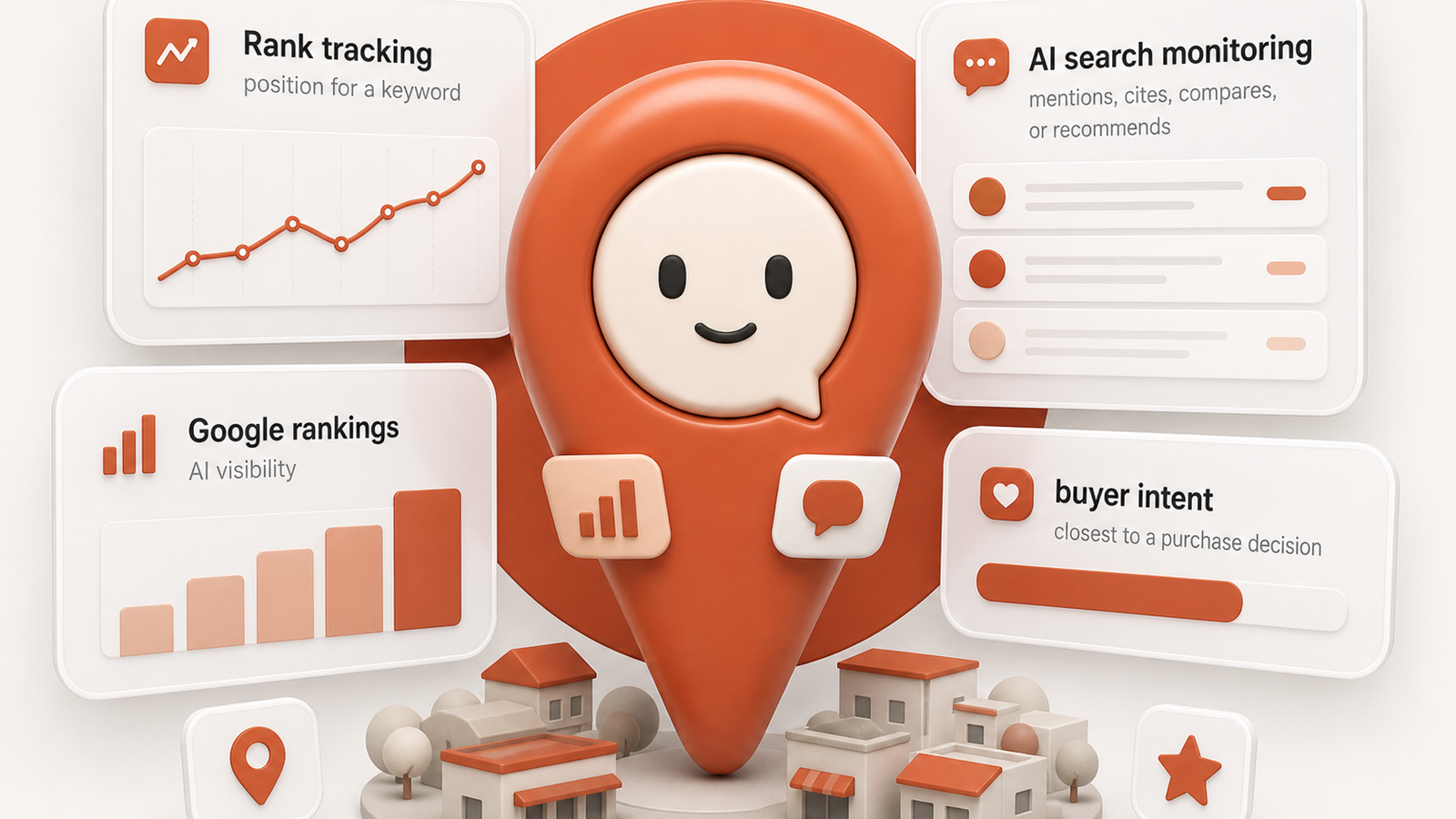
Quick answer: AI search monitoring and rank tracking measure different outcomes. Rank tracking records where your business or page appears in Google results. AI monitoring records whether answer engines mention, cite, compare, or recommend your business for customer prompts. Track both, then use repeated findings to prioritize profile, review, citation, schema, competitor, and content improvements.
AI search monitoring versus rank tracking answers two different questions. Rank tracking tells you your position for a keyword in a defined Google result set. AI monitoring tells you whether an answer engine includes your business when a customer asks for a provider, compares options, or needs help now.
Check the outcome by recording the same Google queries and AI prompts for each target market over time. Keep rankings separate from mentions, citations, and recommendations so the report shows what changed and what work should follow.
What is the difference between AI search monitoring and rank tracking?
Rank tracking monitors a page or business position for a keyword in a specified search engine, device, and location. AI search monitoring checks whether an AI system mentions, cites, compares, or recommends a business for a defined prompt and context. One measures ordered search results; the other records the substance of a generated answer.
A rank tracker might record that a service page is third in organic results or that a Google Business Profile appears in the local pack for a service query in a particular market. The unit is a position: first, third, tenth, or not found within the tracked range.
AI monitoring starts with a customer question rather than a short keyword. It records the answer itself: whether the business appeared, how it was described, which competing businesses appeared, and which visible sources supported the response.
| Measurement area | Rank tracking | AI search monitoring |
|---|---|---|
| Unit measured | Position of a page or business | Inclusion and treatment in an answer |
| Query format | Keyword or short search query | Full prompt with need and context |
| Geographic context | Search engine, device, and location | Prompt location, market, and platform context |
| Evidence collected | Rank, result type, URL, local-pack position | Answer text, mentions, recommendations, citations, competitors |
| Common reporting mistake | Treating a rank as proof of customer choice | Collapsing different answer signals into one score |
| Best use case | Measuring Google organic and local-search position | Measuring recommendation visibility in answer engines |
The reports belong together. A Google ranking can explain part of a business's discovery potential, but it cannot show whether a customer asking an AI assistant for a shortlist receives that business as an option.
Why can a local business rank in Google but not appear in AI recommendations?
A local business can rank in Google and still be absent from an AI recommendation because an AI answer is a generated response, not a numbered copy of Google results.
When you review a missed recommendation, inspect the observed answer for the businesses named, the descriptions used, and the visible sources cited. Those details often show that the response emphasizes a different service fit, review theme, business fact, or competitor description than the Google result you are tracking.
A top-ten organic position is evidence that a page is visible for a particular search result. It does not show whether an answer presents the business as a suitable provider for a specific customer need.
Several gaps commonly separate a visible Google result from an AI recommendation:
- Unclear entity facts: The website, Google Business Profile, and major listings may present incomplete or conflicting names, locations, services, hours, or contact details.
- Thin service-and-location coverage: A business may rank for a broad term while lacking clear pages that connect a service to the market a customer names in a prompt.
- Weak third-party proof: Reviews and local citations can provide details customers use to assess trust, experience, and relevance.
- Competitor specificity: Another business may be described more clearly for the precise need in the prompt, even if it does not outrank you for every related keyword.
- Schema gaps: Local business schema gives search systems structured details that match the business information visible on the page.
Inspect these visibility inputs against repeated omissions. Repair missing or conflicting information, then rerun the same prompt set to see whether the business treatment changes.
Which metrics should you track for AI search visibility versus traditional rankings?
Track Google rankings and AI visibility as separate metrics, then place them in the same report for each service, market, and buyer intent. Rank reports should preserve position and result type; AI reports should preserve the prompt, platform, response, business treatment, cited sources, and competitors named.
For traditional search, track:
- Organic position for priority service and location queries
- Local-pack visibility by market
- Landing page or profile shown
- Search engine, device, and location used for the observation
- Change from the prior reporting period
For AI search, track:
- Prompt and stated market context
- Platform tested
- Whether your business was absent, mentioned, cited, compared, or recommended
- Accuracy of the business information in the response
- Competitors named in the same answer
- Visible sources or citations attached to the response
- Date and method used to repeat the observation
Do not combine these into a single score that hides the difference between being named and being recommended. A business can have a strong local-pack position but no recommendation presence for high-intent questions. It can also appear in an answer despite not holding the first organic position for a related keyword.
What is the difference between a citation, mention, and recommendation?
A citation is a source linked or attributed in an AI answer. A mention is when the answer names the business. An affirmative recommendation goes further: the answer presents the business as a suitable option for the customer's stated need.
For example, an AI response might cite a business website without naming the company in its answer. It might name a company in a long list without endorsing it. Or it might describe a business as a strong option for a defined service, market, or urgent need. Reporting should preserve that distinction.
RankSimply records observed answers and citations separately from recommendation visibility, so a source-only appearance is not mistaken for a customer-facing endorsement. Its Google AI Overview tracking records whether an overview appeared, the brands and sources it surfaced, and the local-pack and organic context around the same query.
What does AI search monitoring measure that rank trackers usually miss?
AI search monitoring measures the actual answer a prospective customer receives, including brand treatment, competitor selection, cited sources, and factual accuracy. Conventional rank tracking usually measures where a result appears, not whether an answer engine turns that result into a recommendation.
That difference matters most on prompts that ask for judgment rather than a destination. A customer may ask for the best provider for a specific service, a business that handles an urgent problem, or a company with evidence of trustworthiness. The response may include a short list, a comparison, a warning, or no business names at all.
AI monitoring also reveals problems that position reports cannot surface on their own:
- Your business is named with an outdated address, service, or status.
- Competitors are repeatedly described as better suited to a specific job.
- A response cites third-party sources while omitting your controlled business information.
- Your business is included in generic prompts but absent from urgent or trust-based prompts.
- Different platforms produce different competitor sets for the same customer need.
Use a consistent prompt set, market context, platform list, and recording method. This produces comparable observations and shows whether a business is repeatedly included, cited, or recommended for the customer questions that matter.
When do you need both AI search monitoring and rank tracking?
You need both when Google search and AI-assisted discovery influence how customers find your business. Rank tracking shows whether priority pages and local listings are visible in Google; AI monitoring shows whether customers receive your business as a relevant recommendation when they ask answer engines for help choosing.
Use rank tracking on its own when the immediate question is narrow: which pages or local listings gained or lost Google visibility for a defined query set. Add AI monitoring when your team needs to know who answer engines recommend instead, what evidence they surface, and whether business facts are accurate in those responses.
This is especially useful for multi-location teams. A brand-level report can hide a location that has strong rankings but weak recommendation visibility in one market. Keep prompts, rankings, competitors, and corrective work tied to the individual location.
For agencies, the same separation avoids a reporting mistake: presenting a change in Google position as proof that a client is now included in AI answers. Each client needs a recommendation baseline, a Google baseline, and an action path that connects observed gaps to the underlying work.
How should local businesses monitor prompts by service, location, and buyer intent?
Local businesses should monitor a focused set of prompts that combine a service, market, and real buying situation. Group prompts by intent so the team can distinguish general discovery from provider comparison, urgent demand, and trust validation instead of treating AI visibility as one broad score.
Start with the services that matter most commercially, then write prompts in the language a customer would use. Useful prompt groups include:
| Buyer intent | Prompt pattern | What to record |
|---|---|---|
| Service discovery | “[service] in [city]” | Inclusion, accuracy, competitors |
| Best-provider search | “best [service] provider in [city]” | Recommendation status and rationale |
| Comparison | “compare [business type] options in [city]” | Businesses compared and distinctions made |
| Urgent need | “who can help with [urgent problem] in [city]?” | Whether the answer identifies a suitable provider |
| Trust validation | “is [business] known for [service or attribute]?” | Accuracy, proof cited, and sentiment |
Keep each prompt specific enough to reflect a real decision. A generic category prompt may show broad awareness; a detailed service-and-market prompt is more likely to reveal whether the business is understood for the work it wants to win.
Run the same prompt set across the relevant platforms and record the exact response. RankSimply supports selected-prompt monitoring across ChatGPT, Claude, Gemini, Perplexity, Grok, Copilot, and Google AI Overviews, with the platforms selected during onboarding. Its reporting keeps platform-level observations visible rather than blending unlike answers into a single estimate.
What should you fix when an AI engine does not recommend your business?
When an AI engine does not recommend your business, first inspect the business facts and supporting evidence behind the answer rather than editing toward the missing phrase. Check profiles, reviews, citation consistency, schema, competitor coverage, and service content, then prioritize the few gaps that affect the highest-intent prompts.
Use this sequence to turn monitoring into work:
- Establish the baseline. Record priority Google rankings and AI prompt results by service, location, and platform before changing anything.
- Identify high-intent gaps. Focus first on prompts tied to provider selection, urgent needs, comparisons, and trust checks.
- Inspect entity and content signals. Compare the business's website, Google Business Profile, review themes, key citations, schema, and service pages with the information and competitors that appear in observed answers.
- Implement coordinated improvements. Correct factual inconsistencies, strengthen profile information, request and respond to reviews, resolve citation issues, improve schema, and publish or update pages that answer a distinct customer question.
- Re-check over a defined evaluation window. Repeat the same rankings and prompts, preserve the evidence, and compare changes by platform and market.
The work should follow the finding. If an answer gives wrong business details, correct the sources that publish those details. If competitors own a service-specific comparison, investigate whether your own service information and proof make that fit clear. If a high-value location is absent across prompts, examine its local profile, listings, pages, and competitor coverage as one record.
RankSimply follows this operational model: monitoring identifies the gap, then its team coordinates profile, review, citation, schema, competitor, and content improvements. Every proposed change receives human approval before it goes live. For a related working checklist, see how to audit AI search presence for a local business.
Frequently asked questions
Can a business appear in ChatGPT or Perplexity even if it does not rank first in Google?
Yes. An AI answer can mention or recommend a business that does not hold the first organic position for a related Google query. Rank tracking records an ordered position for a defined result, while AI monitoring records whether the observed answer includes, cites, compares, or recommends the business for the specific prompt.
How often should businesses check AI search visibility?
Check priority prompts on a recurring schedule that preserves the same wording, market context, platforms, and recording method. A weekly or monthly cadence can show recurring patterns, while a defined re-check window after profile, review, citation, schema, or content work helps connect each observation to the changes made.
Should a local business report one AI visibility score?
No. A single score can hide whether the business was merely cited, named without endorsement, or affirmatively recommended for a valuable service and market. Report each prompt and platform separately, then summarize patterns by buyer intent, location, competitor presence, factual accuracy, and recommendation status.
What should agencies report for each local-business client?
Agencies should report a baseline of priority Google rankings and a separate baseline of AI prompt observations for each client location. The AI record should include prompts, platforms, mentions, citations, recommendations, competitors, and accuracy findings. The action plan should connect each recurring gap to profile, review, citation, schema, competitor, or content work.
How do you turn visibility observations into a work plan?
Start by choosing the services, markets, and customer decisions that matter most. Record the same Google queries and AI prompts, separate positions from citations and recommendations, and prioritize the gaps closest to a purchase decision.
Check the work plan by rerunning the same prompt set and local ranking checks after each group of improvements. Compare the observed answers, competitors, citations, recommendation status, and Google visibility by market.
If your team needs monitoring and corrective work in one workflow, RankSimply tracks recommendations across major AI platforms and Google, identifies the competitors and evidence in observed answers, and coordinates approved visibility improvements. Explore AI visibility tools for local businesses to connect monitoring with practical local-search work.